
ZSI 100 FTM Malleable Penile Implant
A single-body, silver-wire-supported semi-rigid penile implant for the neophallus after phalloplasty.
Product detail →Surgical Implant Inflatable penile implant
A single-cylinder hydraulic penile implant developed for the neophallus after phalloplasty. The cylinder, pelvic reservoir and scrotal pump are supplied pre-connected and pre-filled; controlled inflation provides rigidity and deflation a fully flaccid appearance. The content is institutional technical information for healthcare professionals and procurement teams; it contains no patient referral or treatment advice.
01 Overview
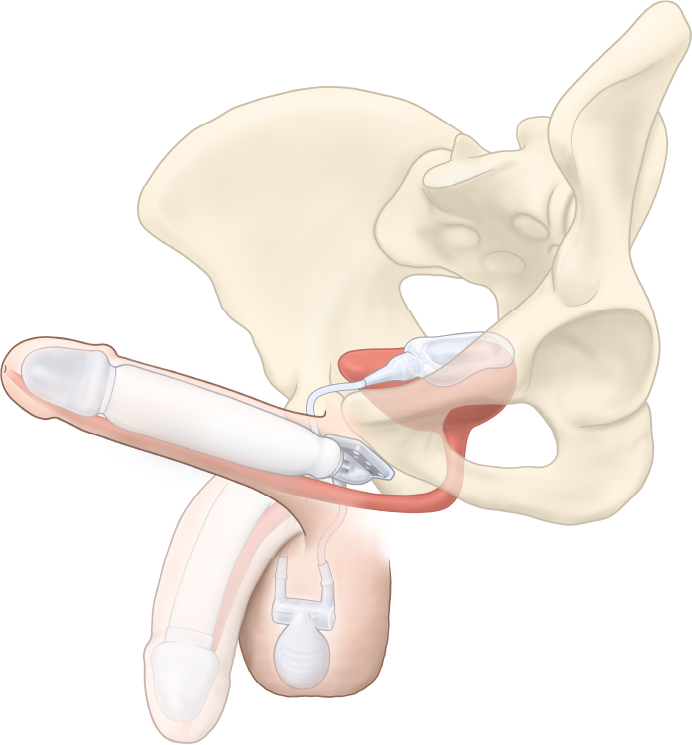
ZSI 475 FTM, designed specifically by the Switzerland-based Zephyr Surgical Implants for patients whose neophallus reconstruction by phalloplasty is complete, is an inflatable penile implant. Unlike conventional penile implants, it is configured for a neophallus anatomy without corpus cavernosum: the single cylinder is placed inside the neophallus, the saline-filled reservoir in the pelvis and the manual pump in the neoscrotum.
The system remains entirely inside the body and is not visible externally. By squeezing the pump in the neoscrotum, the patient transfers fluid from the reservoir to the cylinder; once the desired rigidity is reached, the cylinder maintains the firmness required for penetration. Pressing the valve on top of the pump returns the fluid to the reservoir and the neophallus regains its natural flaccid appearance. This inflatable/deflatable behaviour constitutes the decisive difference from malleable implants in terms of concealment and cosmetic outcome.
Lisa Health provides hospitals and reconstructive urology teams with documented supply of the ZSI penile implant portfolio, sizing planning support and operating theatre preparation documentation. The clinical decision and determination of indication rest solely with the specialist physician.
02 Clinical indications
The ZSI 475 FTM is positioned for reconstructive cases in which rigidity has to be provided in the neophallus. The headings below summarise the clinical contexts most often considered; the final indication, timing and patient suitability are determined solely by the reconstructive urology team.
Contraindications, active infection, insufficient tissue perfusion and assessment of patient compliance are addressed within the framework of the current instructions for use and clinical protocols.
03 Structure and components
The device comes out of the box pre-connected and pre-filled with saline. This approach aims to eliminate connection steps in the operating theatre and thereby reduce the risk of connection error and the manipulation time.
04 Size chart
The cylinder length is chosen according to the neophallus dimensions obtained with phalloplasty. The four-step length range is intended to cover the anatomical variation resulting from different flap techniques.
| Parameter | Value | Clinical note |
|---|---|---|
| Number of cylinders | 1 | Single-cylinder design suited to neophallus anatomy |
| Cylinder lengths | 120 / 150 / 180 / 210 mm | Four steps; selected according to intraoperative measurement |
| Cylinder diameter | 20 – 22 mm | Fullness and stability according to flap volume |
| Glans width | 25 mm | The ventral passage reduces neourethral pressure |
| Rigidity resistance | > 500 g | Above the minimum pressure required for penetration, according to manufacturer data |
| Proximal fixation | Stainless steel + silicone plate | Fixation to the pubic bone |
The dimensions are compiled from the manufacturer's catalogue; final values are confirmed with the official product documentation shared with the institution and the current instructions for use.
05 Operating principle
The system works as a closed hydraulic circuit; fluid is transferred between the reservoir and the cylinder via the pump. Operation is single-handed and requires no external component.
06 Distinguishing advantages
07 Comparison
The decisive criteria in choosing a penile implant after phalloplasty are patient expectation, manual dexterity, tissue quality and cosmetic priorities. The table below compares the two ZSI options for institutional assessment; the clinical preference rests with the specialist physician.
| Criterion | ZSI 475 FTM (inflatable) | ZSI 100 FTM (malleable) |
|---|---|---|
| Operating principle | Hydraulic — inflation/deflation via pump | Semi-rigid — single-handed positioning |
| Flaccid appearance | ✓ Fully flaccid | Permanently semi-rigid |
| Number of components | Cylinder + reservoir + pump | ✓ Single body |
| Surgical complexity | Pelvic and scrotal placement required | ✓ Shorter and simpler procedure |
| Ease of use | Requires pump manipulation | ✓ No mechanical component |
| Length options | 120 / 150 / 180 / 210 mm | Adjustable 200→130 mm and 220→130 mm |
| Warranty | 1 year | 1 year |
08 Technical summary
| Manufacturer / brand | Zephyr Surgical Implants (ZSI) — Geneva, Switzerland |
|---|---|
| Model | ZSI 475 FTM |
| Product family | Surgical implant / penile implant |
| Product type | Inflatable (hydraulic) penile implant |
| Field of use | Neophallus after phalloplasty |
| Components | Single cylinder, pelvic reservoir, neoscrotal manual pump — pre-connected and pre-filled |
| Material | Medical-grade silicone elastomer; stainless steel + silicone proximal plate |
| Coating | PVP + antibiotic |
| Dimensions | Length 120 / 150 / 180 / 210 mm · diameter 20–22 mm · glans 25 mm |
| Rigidity | > 500 g pressure resistance |
| Imaging compatibility | Safe use in medical scanners; not detected by airport scanners |
| Warranty | 1 year (manufacturer) |
| Regulatory status | CE-marked medical device; classification, ÜTS and TİTCK registration details are confirmed with the supply file |
| Documentation | CE certificates, instructions for use, sizing file, surgical technique and training materials |
| Target audience | Reconstructive urology/andrology physicians, procurement and tender units |
09 Questions & answers
The ZSI 475 FTM is considered in order to provide rigidity in cases where neophallus reconstruction with phalloplasty is complete and tissue healing has been achieved. The indication, timing and patient suitability are determined solely by the reconstructive urology team.
The single-cylinder system is offered in four lengths: 120 mm, 150 mm, 180 mm and 210 mm. The cylinder diameter is 20–22 mm and the glans width 25 mm. The final size is selected according to the intraoperative neophallus length.
The inflatable ZSI 475 FTM works hydraulically; it is rigid when inflated with the pump and fully flaccid in appearance when deflated, which is why it stands out for concealment and cosmetic outcome. The malleable ZSI 100 FTM is permanently semi-rigid, is positioned with one hand and involves a shorter operating time and fewer mechanical components. The choice depends on physician assessment.
According to the manufacturer's documentation, the device is designed for safe use with medical imaging equipment and is not detected by airport security scanners. Confirming the institution's protocol and the current instructions for use before imaging is recommended.
Size options, set contents, CE and ÜTS documents, lot/serial traceability and the surgical training plan are compiled according to the institution's procurement format. No public pricing is published; quotations are prepared per institution.
10 Related products
Explore the complementary products in the ZSI surgical implant family and the andrology portfolio.
State your institution type, case profile and the documents you need, and we will respond with size options, surgical training and a quotation schedule.