
Pacey Cuff Male Incontinence Clamp
A non-surgical, external non-invasive male incontinence clamp.
Product detail →Surgical Implant Artificial urinary sphincter (AUS)
A two-component artificial sphincter designed for the surgical treatment of moderate to severe male urinary incontinence. Because the pressure-regulating balloon is integrated into the scrotal pump unit, it requires no component in the pelvic region; the system is supplied pre-connected, pre-filled and ready for implantation. The content is institutional technical information for healthcare professionals and procurement teams; it contains no patient referral or treatment advice.
01 Overview
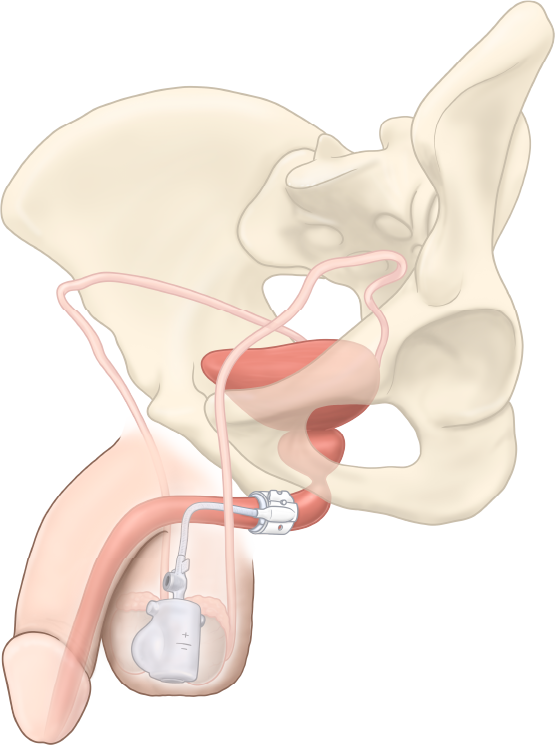
ZSI 375 PF, developed by the Switzerland-based Zephyr Surgical Implants, is an artificial urinary sphincter (AUS). The device is implanted to support the function of the natural urinary sphincter that restricts urine outflow from the bladder, and it mechanically mimics intrinsic sphincter behaviour.
The system's most distinctive design decision is the reduction of the component count to two: the inflatable, adjustable cuff placed around the urethra and the scrotal pump unit housing the pressure-regulating balloon. The reservoir placed in the pelvis in classic three-component systems is eliminated here; there is no component whatsoever in the pelvic region. This approach eliminates the need for pelvic dissection and simplifies surgical planning in cases with a history of previous pelvic surgery or radiotherapy.
The device comes out of the box pre-connected and pre-filled and ready for implantation. This aims to eliminate connection and filling steps in the operating theatre and thereby reduce the risk of connection error and the manipulation time. The implant remains entirely inside the body and is not visible externally.
Lisa Health provides hospitals and functional urology teams with documented supply of the ZSI surgical implant portfolio, cuff sizing planning support and operating theatre preparation documentation. The clinical decision and determination of indication rest solely with the specialist physician.
02 Clinical indications
The artificial urinary sphincter is positioned as the surgical standard option in sphincteric insufficiency where conservative methods are not sufficient. The headings below summarise the clinical contexts most often considered; the final indication, urodynamic assessment and patient suitability are determined solely by the specialist urology team.
Contraindications, active urinary infection, urethral stricture, detrusor overactivity and the patient's manual dexterity/compliance are addressed within the framework of the current instructions for use and clinical protocols.
03 Structure and components
The device is manufactured from medical-grade silicone elastomer and delivered ready for implantation. The design focuses on reducing the number of surgical steps and intraoperative manipulation.
04 Operating principle
The system works as a closed hydraulic circuit and, thanks to its automatic re-inflation feature, restores continence without requiring patient intervention.
05 Technical parameters
| Parameter | Value | Clinical note |
|---|---|---|
| Number of components | 2 (cuff + pump unit) | Pre-connected and pre-filled |
| Cuff length | 4 – 6 cm | Curved design; the adjustable construction accommodates a wide urethral range |
| Pressure regulation | Balloon integrated into the pump unit | No separate pelvic reservoir required |
| Pump placement | Scrotum | Large activation/deactivation buttons |
| Pelvic component | None | Eliminates the need for pelvic dissection |
| Automatic re-inflation | ~2–3 minutes | Continence returns without patient intervention |
| Material | Medical-grade silicone elastomer | Designed for long-term implantation |
| Warranty | 5 years | Scope defined by the manufacturer |
The values are compiled from the manufacturer's catalogue; final parameters are confirmed with the official product documentation shared with the institution and the current instructions for use.
06 Distinguishing advantages
07 Positioning
The treatment steps in male urinary incontinence are structured according to the patient's degree of incontinence, surgical suitability and preference. The table below summarises the institutional positioning of the surgical and non-invasive options in the portfolio; the clinical choice rests with the specialist physician.
| Criterion | ZSI 375 PF (surgical implant) | External clamp / strap |
|---|---|---|
| Approach | Surgical implantation | ✓ Non-invasive, no surgery |
| Degree of incontinence | ✓ Moderate – severe | Mild – moderate |
| Use | Permanent; inside the body, invisible | Applied and removed during the day |
| Continence mechanism | Controlled compression with a urethral cuff | External penile compression |
| Patient intervention | Deflation with the pump; automatic return | Manual opening/closing at every micturition |
| Portfolio equivalent | ZSI 375 PF | Pacey Cuff · Prosecca Strap |
08 Technical summary
| Manufacturer / brand | Zephyr Surgical Implants (ZSI) — Geneva, Switzerland |
|---|---|
| Model | ZSI 375 PF |
| Product family | Surgical implant / male urinary incontinence |
| Product type | Artificial urinary sphincter (AUS) |
| Indication area | Moderate to severe urinary incontinence in men |
| Components | Inflatable adjustable cuff + scrotal pump with pressure-regulating balloon — pre-connected and pre-filled |
| Cuff | Curved, 4–6 cm; quick lock and temporary extension tab |
| Pelvic component | None |
| Material | Medical-grade silicone elastomer |
| Automatic re-inflation | Approximately 2–3 minutes |
| Additional design elements | Hydraulic septum (access through the scrotum), silencer, large activation buttons |
| Imaging compatibility | Safe use in medical scanners; not detected by airport scanners |
| Warranty | 5 years (manufacturer) |
| Regulatory status | CE-marked medical device; classification, ÜTS and TİTCK registration details are confirmed with the supply file |
| Documentation | CE certificates, instructions for use, cuff sizing file, surgical technique and training materials |
| Target audience | Urology and functional urology physicians, procurement and tender units |
09 Questions & answers
An artificial urinary sphincter (AUS) is an implantable device that supports the natural urinary sphincter's function of restricting urine flow. In the ZSI 375 PF, the inflatable cuff placed around the urethra provides continence by compressing the urethra; when the patient squeezes and releases the pump in the scrotum, the cuff deflates, the urethra is decompressed and the bladder is emptied. After approximately 2–3 minutes the cuff automatically re-inflates and restores continence.
The device is considered in cases of moderate to severe urinary incontinence in men; it most often comes into question in sphincteric insufficiency after radical prostatectomy. The indication, urodynamic assessment and patient suitability are determined solely by the specialist urology team.
The cuff has a curved design and offers a length between 4 cm and 6 cm. Its inflatable, adjustable construction is designed to accommodate different urethral diameters, so that a wide anatomical range is covered with a single cuff configuration.
In classic three-component systems the pressure-regulating reservoir is placed in the pelvis. In the ZSI 375 PF the pressure-regulating balloon is integrated inside the pump unit in the scrotum; there is no component whatsoever in the pelvic region. This eliminates the need for pelvic dissection and simplifies surgical planning, particularly in cases with a history of previous pelvic surgery or radiotherapy.
The manufacturer defines a warranty period of 5 years. Cuff size options, set contents, CE and ÜTS documents, lot/serial traceability, the surgical technique document and the training plan are compiled according to the institution's procurement format. No public pricing is published.
10 Related products
Explore the complementary products in the surgical implant family and the male incontinence portfolio.
State your institution type, case profile and the documents you need, and we will respond with cuff sizes, surgical training and a quotation schedule.